How much concrete do I need for a patio?
Work out cubic yards for a concrete patio with one formula, add a sensible overage, and decide between bagged mix and a truck delivery.
5 min read · Updated ·
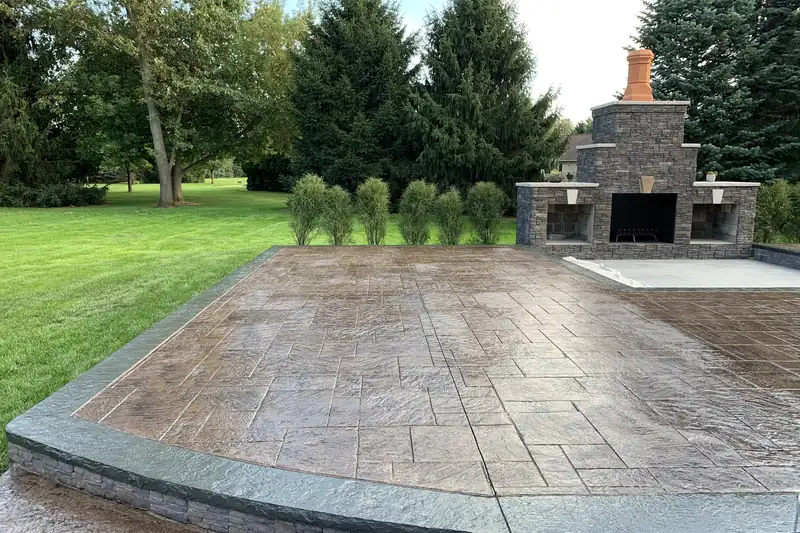
Concrete is ordered by volume — cubic yards in the US. Measure the patio, pick a thickness, and the math is one line. Getting it right matters: running short mid-pour leaves a cold joint, and over-ordering means paying to haul concrete away.
The formula
Cubic yards = length (ft) × width (ft) × thickness (ft) ÷ 27. There are 27 cubic feet in a cubic yard. Convert thickness from inches to feet by dividing by 12 (4 in = 0.333 ft).
- 12 ft × 12 ft patio at 4 in thick: 12 × 12 × 0.333 = 48 cubic feet ÷ 27 = 1.78 cubic yards.
- 10 ft × 20 ft at 4 in: 10 × 20 × 0.333 = 66.7 cu ft ÷ 27 = 2.47 cubic yards.
- Odd shapes: split the patio into rectangles and circles (area = 3.1416 × radius²), add the areas, then multiply by thickness.
- Or let the concrete slab calculator do the math, including bags and an overage.
Add a little extra
Forms bow, subgrade dips and some concrete stays in the chute or wheelbarrow. Many contractors add a small overage — often in the 5–10% range — rather than order the exact number. Measure the actual depth of your forms in several spots before you call; a base that is half an inch low across a whole patio adds up fast.
Bags or a truck?
Bagged mix is sold by weight. QUIKRETE lists an 80 lb bag of its Concrete Mix as yielding about 0.60 cubic feet, so one cubic yard takes about 45 of those bags. That is a lot of mixing for anything beyond a small pad.
For a patio-size pour, a delivered load is usually easier and gives you one consistent batch. If you only need a yard or two, look for short-load concrete or a volumetric (mix-on-site) truck, which batches on site so you pay for what you pour. For larger pours, a ready-mix plant is the usual choice.
Thickness
Four inches is the common thickness for a walk-on patio slab. Go thicker where something heavy will sit — a hot tub, a masonry fireplace, or a vehicle — and follow your local building code or the manufacturer’s instructions for that load.
Before you call the supplier
- Total cubic yards (with overage).
- Where the truck can park and how far concrete has to travel — chute, wheelbarrow or pump.
- Whether you want a decorative finish such as stamped or colored concrete.
- A date with a dry forecast and a backup day.
Common questions
How many cubic yards is a 10x10 patio at 4 inches?
10 × 10 × 0.333 = 33.3 cubic feet, ÷ 27 = about 1.23 cubic yards before any overage.
How many 80 lb bags make a cubic yard?
At the manufacturer-listed yield of about 0.60 cubic feet per 80 lb bag (QUIKRETE Concrete Mix), roughly 45 bags make one cubic yard.
Sources
General information only. Codes, soils and climates vary — check your local building department and follow product instructions.