Spalling, scaling, and first-winter care for new concrete
What spalling and scaling look like, why deicers damage new concrete in the first winter, when sealing helps, and when to call a contractor for repair, resurfacing or leveling.
7 min read · Updated ·
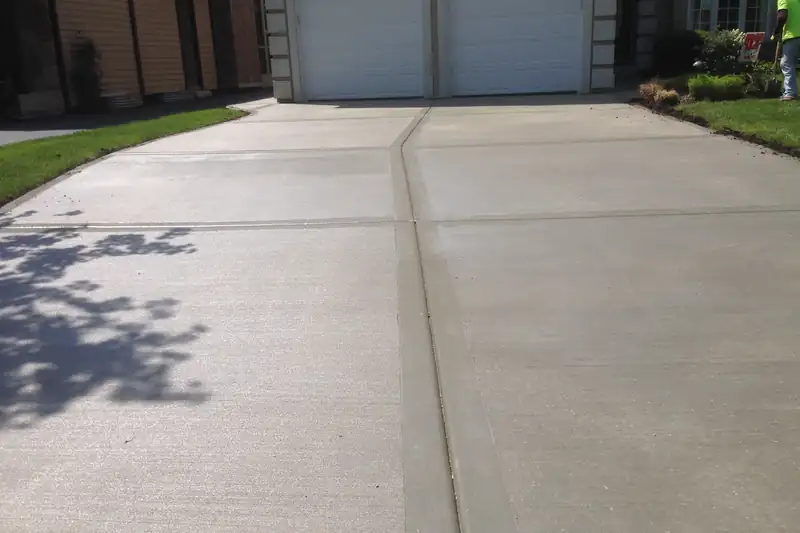
Every spring, some homeowners find that a driveway or sidewalk poured the year before has a flaky, pitted surface that was not there in the fall. That damage has a name — scaling, often called spalling — and deicing salt in the first winter is one of the usual causes. The good news is that most of it is preventable.
What spalling and scaling look like
Scaling is the term the National Ready Mixed Concrete Association uses for a surface that flakes or peels, usually in thin layers of mortar, leaving a rough, pitted finish. Homeowners often call the same damage spalling. In everyday use the two words overlap; engineers sometimes reserve “spalling” for deeper chunks breaking off, including around joints or corroding steel.
On a driveway or sidewalk you will typically see pop-outs, a sandy or pocked surface, and patches where the smooth finish has come off. It often shows up first after the first winter, especially where snow piled up, where cars track in road salt, or where water stands.
Why the first winter is the risky one
Fresh concrete needs time to gain strength and to dry after the initial cure. Freeze–thaw cycles, especially with deicing chemicals, put extra stress on a surface that is still maturing. NRMCA’s Concrete in Practice sheet on scaling (CIP 2) is direct: do not use deicing chemicals in the first winter, and use clean sand for traction instead. The Pennsylvania Aggregates and Concrete Association, citing the same industry guidance, likewise recommends against deicers in the first year of a pavement’s life.
Even later, deicers amplify freeze–thaw damage. CIP 2 notes that calcium chloride and sodium chloride (rock salt) are generally considered acceptable on good-quality mature concrete, used in moderate amounts — and that ammonium sulfate, ammonium nitrate, and magnesium-based salts are chemically aggressive and can destroy a concrete surface. Fertilizers often contain ammonium compounds; keep them off the slab.
What has to be right in the concrete itself
A well-built exterior slab in freeze–thaw country is normally air-entrained (tiny bubbles that give freezing water room to expand), placed at a moderate slump, finished after bleed water has left the surface — not with a steel trowel on an outdoor slab — and cured so the surface does not dry out too fast. CIP 2 also points to adequate strength: on the order of 3,500 psi for freeze–thaw exposure and about 4,000 psi when deicers will be used. Tell your ready-mix supplier the slab is an exterior driveway or walk so they can suggest an appropriate mix.
If you are pouring late in the fall, read pouring and curing concrete in cold weather. ACI 306R treats cold-weather conditions as when the air temperature has fallen to, or is expected to fall below, 40°F (4°C) during the protection period. Do not place concrete on frozen ground, and protect the slab from freezing until it has gained early strength.
Four rules for a first-year driveway
- No deicers in the first winter. Shovel with a plastic shovel rather than chipping ice, and use clean sand for traction. When the weather allows, rinse off salt that cars track in from the street.
- Never use ammonium or magnesium-based deicers on concrete, even on older slabs.
- Keep water moving. Standing water and piled snow keep the surface saturated, which makes freeze–thaw damage worse. Driveway basics covers slope, joints and drainage.
- Seal only after the slab has cured and is dry. A sealer is not a substitute for a good mix, finish and cure, but a breathable silane or siloxane sealer made for exterior concrete can add protection. NRMCA CIP 2 says the concrete should be reasonably dry before you apply it, and that late summer after a few dry days is an ideal time. Follow the product data sheet for coverage and recoat intervals — or size the job with the concrete sealer calculator.
When sealing helps — and when you need a repair
Sealing a sound, fully cured slab can slow water and chloride from soaking in. It will not glue a weak, already-scaled surface back together. If the finish is already flaking, a flatwork contractor should look at whether the damage is shallow (sometimes a resurfacing overlay is an option) or whether the slab should be replaced. Cost to resurface or replace varies with thickness, access and how much has to come out; use the driveway cost calculator and the demolition calculator as planning tools, then get a written local quote.
When the slab has also settled
If a panel has dropped, you have a trip edge, or water now ponds against the house, the problem may be the base, not only the surface. Mudjacking or polyurethane foam lifting can raise a sound slab without a full tear-out. The leveling calculator below estimates the sunken area and a starting cost; browse concrete leveling contractors or leveling near you. A badly cracked slab, a failed base, or a very large drop may need replacement instead.
Common questions
What causes spalling on a new concrete driveway?
The usual combination is freeze–thaw cycles plus moisture, often with deicing salt, on a surface that was not air-entrained, was over-finished, was not cured, or was still young. NRMCA CIP 2 walks through each of those causes.
Can I use rock salt on a concrete driveway?
Not in the first winter, if you can avoid it. On a mature, air-entrained, well-cured slab, CIP 2 treats sodium chloride and calcium chloride as acceptable when used in moderate amounts. Never use ammonium sulfate, ammonium nitrate, or magnesium-based deicers.
When can I seal a new driveway?
After it has cured and is reasonably dry. Industry guidance often points to waiting through the initial cure (commonly discussed around 28 days) and applying a breathable sealer on a dry day, ideally well before the first hard freeze — or in late summer on a slab poured earlier in the year. Follow the sealer manufacturer’s data sheet.
Is scaling the same as a structural failure?
Usually no. Scaling is surface damage. If the slab has deep cracks, dropped along a joint, or hollow areas underneath, have a contractor check whether leveling or replacement is needed.
Sources
General information only. Codes, soils and climates vary — check your local building department and follow product instructions.