Hire a licensed builder · Not a DIY guide
How to hire a pool builder
A practical hiring guide for a concrete pool: license and insurance checks, ACI-certified nozzlemen, payment-schedule rules (including California’s cap), contract items, questions to ask and red flags.
8 min read · Updated ·
The quality of a concrete pool is the quality of the crew that builds it. Licenses, insurance, a written contract, and a payment schedule that does not get ahead of the work will do more for you than a glossy rendering. This is the same instinct you would use to choose a concrete contractor, applied to a longer, more specialized job.
Confirm the license, the specialty and the insurance
Look up the company on your state contractor board before you fall in love with a design. Many states license swimming-pool or pool-and-spa work as its own classification; others fold it into a general or specialty contractor license. The name on the license should match the name on the contract and the insurance certificate.
Ask for current general liability and workers’ compensation certificates, sent by the agent, with you listed as a certificate holder if that is customary in your state. A bond is not the same as insurance; some states require a contractor bond, and a performance bond is a separate conversation on a large job. Membership in a trade group such as the Pool & Hot Tub Alliance (which includes the former Association of Pool & Spa Professionals) is a plus, not a substitute for a license.
Ask who will shoot the shell
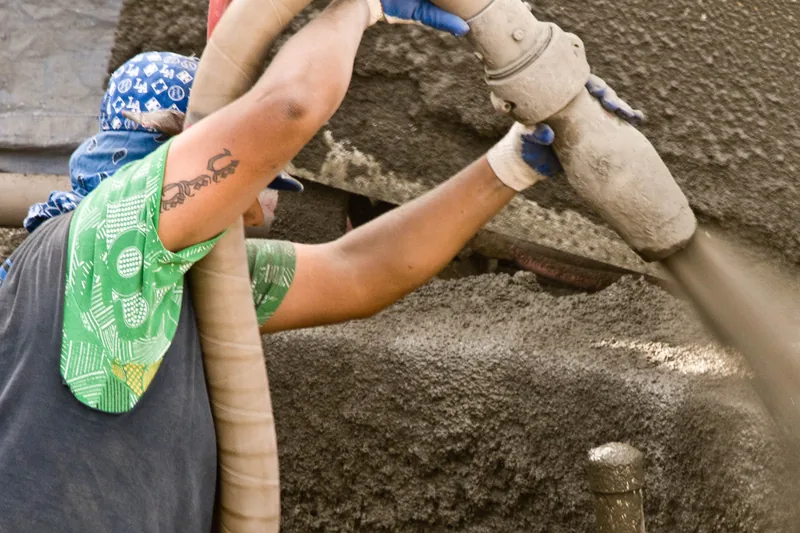
On a sprayed concrete pool, the nozzleman is a skilled trade. The American Concrete Institute certifies Shotcrete Nozzlemen on the wet-mix or dry-mix process, and in vertical or overhead orientations. Ask whether the person on the nozzle — not just “a guy on the crew” — holds the ACI certification that matches the process in your contract, and how rebound will be handled. Browse shotcrete and gunite contractors as well as pool builders; some shells are subcontracted. Confirm who holds the contract with you.
Payment schedules, and one clear state rule
A healthy schedule is a modest down payment, then progress payments that follow finished, inspected work — steel, shell, tile and deck, interior finish, and a retainage until startup and punch-list items are done. Exact percentages are a matter for your contract and your state law; we are not going to invent a “standard” 30/30/30 split.
California is explicit, and it is a useful benchmark even if you live elsewhere. Under Business and Professions Code section 7159.5, if a down payment is charged on a home-improvement contract, it may not exceed $1,000 or 10 percent of the contract amount, whichever is less. Except for that down payment, the contractor may not request or accept payment that exceeds the value of the work performed or materials delivered. The Contractors State License Board repeats that cap for swimming-pool jobs, notes that there are no exceptions for special-order materials, and says swimming-pool contracts must include a plan and scale drawing. A schedule of payments in dollars and cents, tied to work completed, has to be in the contract. (Some bonded arrangements can change parts of that framework; read the statute and the CSLB guide rather than taking a contractor’s word that they are “exempt.”)
Other states have their own contract and down-payment rules. Check your contractor board — in Oregon, that is the Construction Contractors Board — and do not assume California’s cap applies next door.
What belongs in the contract
- The legal name, address and license number of the contractor, and any subcontractors who will shoot the shell, plaster, or build the deck.
- A plan and specifications: shape, dimensions, depths, steel, shell process (dry-mix or wet-mix), interior finish by product name, tile and coping, deck material and area, equipment by make and model, and the barrier.
- Who pulls which permits, who calls 811, and who builds or certifies the fence.
- A start window, a substantial-completion target, and what happens when weather or inspections delay the work.
- A payment schedule in dollars, tied to completed stages, and a written change-order process.
- Warranties — structure, finish, equipment — in writing, with what voids them.
- Cleanup, spoil haul-off, and site restoration. Access limits (how close a truck can get) should be honest up front.
Questions worth asking
- How many concrete (or fiberglass, or liner) pools has this company completed in my county in the last two years, and can I see them or talk to those owners?
- Who is the nozzleman, and are they ACI-certified for this process?
- What is the curing plan for the shell, and who does the interior finish?
- What do you do if you hit rock or groundwater?
- Is the fence, the deck and the electrical work in this number, or allowances?
- How do you handle startup chemistry, and when is the pool actually ours to swim?
- Who is the contact when something is late or wrong?
Red flags
- Pressure to pay a large cash deposit, or a down payment that would break a rule like California’s $1,000 / 10 percent cap.
- No written contract, or a contract with no plan, no finish specified, and no payment schedule.
- An offer to skip the permit or the fence “to save you money.”
- A license number that does not come up, or insurance that cannot be verified with the agency.
- A bid far below serious competitors for the same scope, with vague allowances.
- Unwillingness to discuss rebound, inspections, or who is actually shooting the shell.
Find people who actually do this work
Start with ConcreteNear’s pool builders and pool-work listings, which we tag only when the business name or the company’s own website shows pool, gunite-pool or pool-deck work. Also look at shotcrete and gunite contractors and concrete contractors, and confirm pool work before you hire. A long driveway and a custom pool are not the same job.
Common questions
How much should I pay up front?
It depends on your state. In California, the down payment on a home-improvement or swimming-pool contract cannot exceed $1,000 or 10 percent of the contract price, whichever is less, and later payments cannot get ahead of the work performed. Elsewhere, follow your contractor board and keep payments tied to completed stages.
What is an ACI-certified nozzleman?
The American Concrete Institute certifies shotcrete nozzlemen by process (wet-mix or dry-mix) and by orientation. On a sprayed pool shell, asking for that certification is a reasonable way to check that the person at the hose has been tested on the work you are buying.
How many bids should I get?
Enough written bids, on the same scope, to compare process, finish, deck, fence and equipment line by line — not just the bottom line. Two or three serious proposals is a common practice; the number matters less than whether they describe the same pool.
Sources
General information for hiring a professional. Codes, soils and climates vary — check your local building department and follow the contract and product instructions. This is not a do-it-yourself guide. Written with 25 years in concrete, from Oregon City, Oregon.