Hire a licensed builder · Not a DIY guide
What a concrete pool costs
Current published ranges for building a concrete or gunite pool, what actually drives the bid, and how to read extras like decks, fences and permits — with sources, not invented numbers.
8 min read · Updated ·
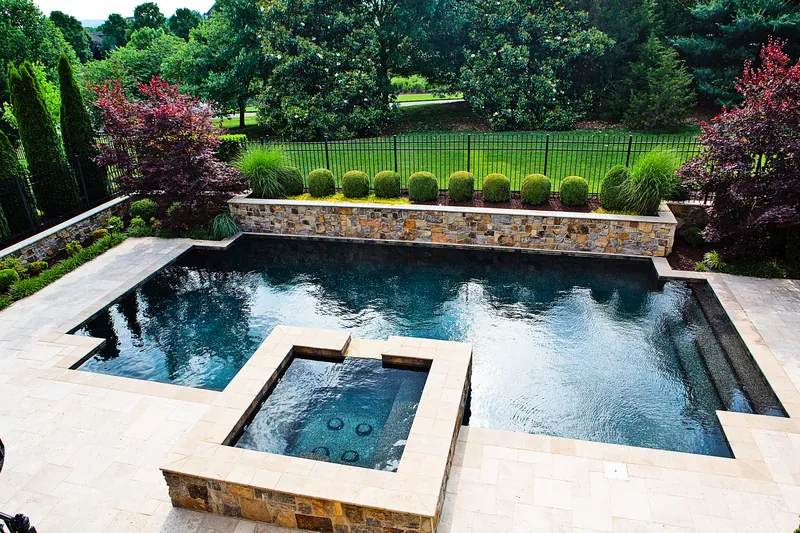
A custom concrete pool is one of the larger home-improvement checks most families will write. Cost guides disagree on the exact average, which is itself a useful warning: treat published numbers as planning brackets, then collect written bids for your lot. The figures below are from current public guides, not from a phone-book guess.
What the 2026 guides actually say
Two widely used guides, two midpoints: Angi at about $66,000 for in-ground pools of all materials, and HomeGuide at about $85,000 for concrete. Concrete sits at the high end of both material tables. Luxury shapes, poor access, rock or a high water table leave those brackets behind. Get local pool builders to price the same scope.
| Source | What it measures | Published figures |
|---|---|---|
| Angi, in-ground pool guide (updated Oct. 14, 2026) | National in-ground installation, 1,467 verified Angi Pro projects | Average $65,909; most projects $44,499–$87,349; overall range from about $14,000 up to $135,000 for larger or more complex jobs |
| Angi, same guide, by material | Typical installation ranges | Vinyl $40,000–$75,000; fiberglass $55,000–$100,000; concrete $65,000–$120,000 |
| HomeGuide, concrete pool cost (2026 page) | Concrete / gunite, installed | Typical range $50,000–$120,000; national average $85,000; reported minimum $30,000 and maximum $200,000 |
| HomeGuide, same page, other in-ground types | Typical installed ranges | Fiberglass $45,000–$100,000; vinyl $35,000–$80,000 |
Angi’s broader “cost to build a pool” article mixes in-ground and above-ground work and shows a lower overall average; the figures above are from the in-ground-specific guide. Per-square-foot tables on these sites do not always line up with the size examples on the same page, so we do not treat any one $/sq ft figure as a rule.
What actually drives the bid
- Size and depth. More water, more steel, more sprayed concrete, more finish, more excavation.
- Shape and features. A rectangle is simpler than a freeform with a spa, tanning ledge, waterfall or vanishing edge. Angi lists example style figures (for example a lap pool around $44,000 and lagoon-style work at $100,000 or more) as illustrations, not guarantees.
- The site. Slope, rock, poor soils, groundwater, tight access, overhead utilities, tree roots and tearing out an old patio or pool can outweigh the difference between two shell types. See excavation and demolition.
- Where you live. Angi publishes wide state ranges (for example California $59,000–$140,000 and Florida $38,200–$101,328 in its 2026 in-ground guide). Labor, season and how common pools are in the market all show up in the bid.
- Finish and deck. Plaster vs. quartz vs. pebble, tile, coping stone, and whether the deck is broom-finished concrete, stamped work, pavers or stone. HomeGuide cites pool decks at $25–$50 per square foot depending on material; Angi lists a broad add-on of $3,000–$12,000 for decking, which will not cover a large custom deck.
- Code items. Permits, inspections, the barrier, and electrical work including bonding. Angi lists permits at $450–$1,800 and fences at $1,500–$10,000; HomeGuide’s permit line is lower ($100–$300+) and its fence line is $20–$60 per linear foot. Jurisdictions vary — ask what is in the bid.
- Equipment. Pumps, filters, heaters or heat pumps, covers, lighting and automation are often optional lines. HomeGuide and Angi both publish add-on ranges; compare them as allowances, not as your quote.
What to budget besides the shell
Families often price “the pool” and then meet the fence, the deck, the landscaping and the first year’s service. Angi also lists typical annual in-ground concrete maintenance in the $2,700–$4,000 range, and HomeGuide cites professional service visits around $80–$150 a month. Chemicals, water, power, opening and closing in cold climates, and a future replaster are part of owning the thing, not a surprise tax.
How to use these numbers with a contractor
Hand every bidder the same scope: size, depths, finish, deck area and material, equipment, who pulls permits, who builds the fence, and what happens if they hit rock. A low number that leaves out the barrier or the deck is not a savings. Payment timing belongs in the contract — see hiring a pool builder, including California’s statutory cap on down payments.
If a bid is far below both of these guides for a custom concrete pool with a deck and fence, ask what was omitted before you celebrate.
Common questions
How much does a concrete or gunite pool cost in 2026?
HomeGuide’s 2026 concrete-pool guide lists a typical installed range of $50,000 to $120,000 (average $85,000). Angi’s 2026 in-ground guide lists concrete installation at $65,000 to $120,000, with a national in-ground average of $65,909 across materials. Your lot, access and features will move the number.
Does a pool pay for itself in resale?
Not reliably, and not at a single rate. Angi notes that return on investment for a pool is a very wide range and is often lower than projects such as a kitchen remodel, because not every buyer wants the upkeep. Treat the pool as something you will use, not as a guaranteed financial instrument.
Are above-ground pools in these averages?
Not in the concrete figures above. Angi and HomeGuide publish much lower ranges for above-ground pools. Angi’s separate “cost to build a pool” average is pulled down when above-ground work is mixed in, which is why we cite the in-ground guide for this article.
Sources
General information for hiring a professional. Codes, soils and climates vary — check your local building department and follow the contract and product instructions. This is not a do-it-yourself guide. Written with 25 years in concrete, from Oregon City, Oregon.