Hire a licensed builder · Not a DIY guide
Pool permits, fencing and barrier codes
What homeowners should know about pool permits and barriers: typical International Swimming Pool and Spa Code (ISPSC) fence and gate rules, construction fencing, and why your city or county is the last word.
6 min read · Updated ·
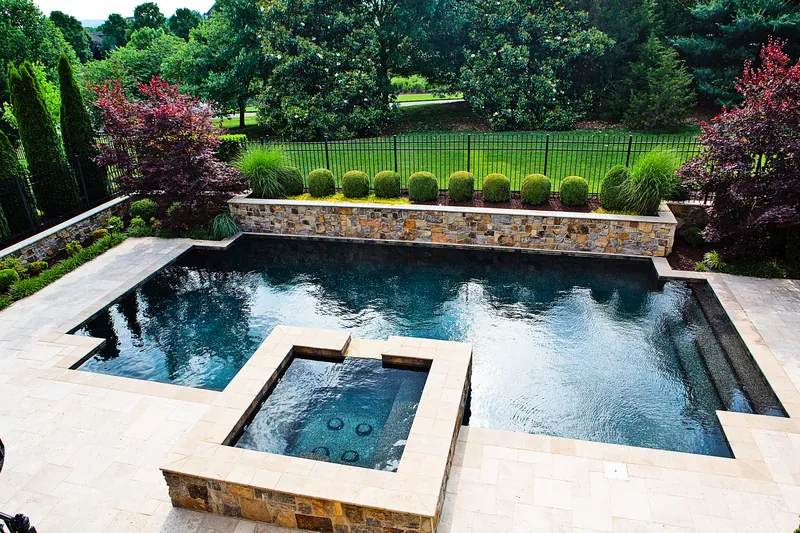
An in-ground pool is a permitted structure, and a fence is not a decoration. Model codes — especially the International Swimming Pool and Spa Code — are the template many cities and states adopt or amend. The version on the books where you live, plus any state safety act, is what the inspector will enforce. Have your builder pull the right permits, and read the barrier rules yourself before you sign.
Permits come first
Most jurisdictions require a building permit for an in-ground pool, and often separate electrical (and sometimes plumbing or gas) permits. Plan-review can ask for setbacks, easements, lot coverage, a site plan, structural details, equipment location, and a barrier drawing. HOA architectural review, where you have one, is a second clock — run it with the permit, not after.
Ask, in the contract, who submits what, who pays the fees, and which inspections are expected (steel and bonding before the shell is shot is a common hold point). Published cost guides disagree on typical permit fees — Angi’s 2026 in-ground guide lists $450 to $1,800, HomeGuide cites $100 to $300+ — because the fee is local. Treat it as a line item, not a rounding error.
Call 811, even on a permitted job
A permit does not locate buried utilities. The crew should contact 811 before excavation. Private lines (a gas line to a fire pit, a low-voltage run, an irrigation main past the meter) are often not marked by the one-call system; those are on you and the contractor to figure out.
Barrier basics in the model ISPSC
The International Swimming Pool and Spa Code, Section 305, is the model language many inspectors have in mind. In the 2024 ISPSC, outdoor pools and spas are to be surrounded by a barrier that, among other things, is at least 48 inches high, measured on the outside, all the way around, and for a short distance out from the fence; openings cannot pass a 4-inch sphere; and the gap at the bottom is limited (2 inches over grass or gravel, 4 inches over a solid surface such as concrete, again measured on the outside). Pedestrian gates are to open outward, away from the pool, and be self-closing and self-latching, with a way to lock them. Where a latch can be reached from outside without a key or combination, the release is to be at least 54 inches above grade.
The same section allows some exceptions when a pool or spa has a listed safety cover that meets ASTM F1346 — that is a code option, not a reason to skip a conversation with your building department. Where a house wall is part of the barrier, doors and windows that open to the pool are typically required to have alarms or other listed protections. Mesh fences and screen enclosures have their own rules if they are used as the barrier.
The U.S. Consumer Product Safety Commission’s Safety Barrier Guidelines for Residential Pools also recommend a fence at least 4 feet high (and prefer 5 feet or more), and they emphasize layers of protection: a fence that does not use the house as a fourth side is better, and door alarms matter when it does. Guidelines are not a substitute for the code you are inspected under.
Construction fencing is part of the code, too
The 2024 ISPSC (Section 305.1.1) requires construction fencing at least 4 feet high around an in-ground pool or spa excavation from the time digging starts until the permanent barrier is finished. A hole in the yard is a hazard. If your builder is casual about that, it is a problem, not a paperwork detail.
Check your jurisdiction — and your state
Cities amend the model code. Counties adopt different years. Some states have their own pool-safety statutes on top of the building code. Florida, for example, has long had a residential swimming-pool safety act with its own menu of protection options. None of that can be read off a national blog and treated as final.
Before you sign, get the local barrier handout from the building department, or have the builder attach it to the contract. The pretty railing in a rendering is not automatically a legal barrier. For the broader hiring picture, see how to hire a pool builder.
Common questions
How tall does a pool fence have to be?
Under the model 2024 ISPSC, the barrier is at least 48 inches high, measured on the side away from the pool, around the entire perimeter. The CPSC’s guideline is also a 4-foot minimum, and it prefers 5 feet or more. Your city may be stricter. Check the adopted code.
Which way should the gate swing?
The model ISPSC requires pedestrian gates to open outward, away from the pool, and to be self-closing and self-latching. Latch height and lock rules are in the same section. Confirm the adopted version locally.
Can a pool cover replace a fence?
Sometimes, if the cover is a listed safety cover that meets ASTM F1346 and your adopted code allows that exception. Many families still install a barrier. Only your building official can tell you what will pass inspection.
Sources
- International Code Council — 2024 International Swimming Pool and Spa Code (ISPSC), including Section 305 barrier requirements
- Henrico County, Va. — 2025 ISPSC pool barrier summary (public handout of Section 305)
- U.S. CPSC — Safety Barrier Guidelines for Residential Pools (Pub. 362)
- Call 811
- Angi — How much does an in-ground pool cost? (2026 permit fee range)
- HomeGuide — How much does a concrete pool cost? (2026 permit fee range)
General information for hiring a professional. Codes, soils and climates vary — check your local building department and follow the contract and product instructions. This is not a do-it-yourself guide. Written with 25 years in concrete, from Oregon City, Oregon.